

THE HIDDEN ARCHITECTURE OF POWER
Why Europe Must Learn to See the Connections Before They Become Dependencies
By Alexander Tsolkas
We see the news every day. China restricts access to critical raw materials. The United States turns export controls and technology into instruments of economic policy. Europe introduces new regulations on artificial intelligence, cybersecurity, supply chains and industrial production. Energy prices influence investment decisions. Cloud platforms become critical infrastructure. Technical standards determine which products will still have access to international markets tomorrow.
Each of these developments is reported separately.
But the real story lies between them.
That is where The Hidden Architecture of Power begins.
POWER HAS CHANGED ITS FORM
When we think about power, we usually think about governments, elections, armies, borders and political leaders. Yet some of the most consequential forms of power in the twenty-first century operate much deeper inside the systems on which modern economies depend.
Who controls critical raw materials? Who owns semiconductor technology? Which companies operate the cloud infrastructure on which governments and corporations depend? Who defines technical standards? Under which jurisdiction is our data processed? Who controls the energy required by European industry? And who owns technologies without which entire value chains can no longer function?
These are no longer separate questions.
A law passed in Washington can affect whether a German vehicle may still be sold in the United States. An export restriction in Beijing can disrupt a European production line. A technical standard can determine whether an industrial manufacturer retains access to a market five years from now. An energy decision can influence where the next chemical plant, semiconductor factory or data centre will be built.
And a seemingly technical cloud decision can become a question of strategic sovereignty.
Yet governments still organise reality into portfolios. Foreign affairs here. Economics there. Finance somewhere else. Energy, technology, cybersecurity and industrial policy in separate structures.
Companies often do the same. Procurement, engineering, compliance, IT, security, legal and strategy each see their own part of the picture.
But markets do not respect organisational charts. China does not. The United States does not. Technology does not. And crises certainly do not.
EUROPE IS BEGINNING TO SEE THE PROBLEM
The consequences are becoming increasingly visible. European companies are redesigning supply chains because geopolitical disruption is no longer regarded as an exceptional event but as a structural feature of international business. Tariffs and regulatory compliance have already overtaken traditional logistics and input shortages as major trade obstacles.
At the same time, Europe remains deeply dependent on external sources for critical raw materials, semiconductors, cloud technologies, batteries and other strategic inputs.
The uncomfortable question is therefore no longer whether Europe has dependencies. It does.
The question is whether we identify them early enough to retain options.
Because once a dependency becomes visible during a crisis, strategic freedom has often already disappeared.
THE QUESTION IS NOT ONLY WHAT HAPPENED. IT IS WHAT HAPPENS NEXT.
The Hidden Architecture of Power therefore looks beyond individual political events.
What does a decision mean for European companies? Which products will be affected? Which supply chains will change? Which technology might become unavailable? Which new dependency emerges when an old dependency is removed? Who gains economic leverage? Who pays the price? And when does economic efficiency become strategic vulnerability?
Consider a modern vehicle. It is no longer simply steel, an engine and software. Behind it stand semiconductors, rare earths, batteries, sensors, cloud services, data, certification regimes, patents, energy, logistics, capital and international law.
Look only at the vehicle and you see a product. Look at the layers underneath it and you begin to see the architecture of power.
The same applies to artificial intelligence. AI requires computing power. Computing requires semiconductors. Semiconductor production requires highly specialised machinery, materials and intellectual property. Data centres require electricity, water, grids and capital. Cloud infrastructure belongs to companies operating under particular jurisdictions.
Suddenly AI is no longer merely a technology issue.
It becomes industrial policy, energy policy, raw-material policy, security policy, financial policy and geopolitics at the same time.
That is the perspective this book develops.
FROM ANALYSIS TO ACTION: ESIR
Recognising the architecture is not enough.
Europe needs the capability to see changes before they become crises.
This is why I developed the concept of ESIR – European Strategic Industry Radar (© Alexander Tsolkas, 2026).
ESIR is conceived as an independent, industry-led geoeconomic intelligence and early-warning capability.
Not another ministry. Not another political bureaucracy. Not another organisation producing reports after the damage has occurred. A strategic radar for European industry.
ESIR would continuously monitor developments that are usually examined separately: proposed legislation, technical standards, certification regimes, sanctions, export controls, tariffs, subsidies, ownership changes, critical raw materials, energy, semiconductors, artificial intelligence, cloud infrastructure, supply chains, capital flows and emerging technologies.
But collecting information would only be the beginning.
The real task is translation. What does a new US law mean for a European automotive manufacturer? What does a Chinese export restriction mean for a particular machine, battery, sensor or production line? What does a new EU regulation mean when its effects on energy, investment, innovation and international competitiveness are considered together? What does an agreement between Washington and Beijing mean for European industry even though Europe was not sitting at the negotiating table?
ESIR would therefore ask systematically: Which sector is affected? Which company? Which technology? Which supply chain? Which individual product? Which market? What is the time horizon? What dependency is emerging? And what options remain?
This is the missing layer between global events and industrial decision-making.
WHY ESIR SHOULD BE CLOSE TO INDUSTRY
The people who understand these consequences are not located in one ministry or institution.
They are spread across companies, engineering departments, economic research, legal practice, standards organisations, cybersecurity, intelligence analysis, supply-chain management, energy markets, capital markets and technology.
ESIR would bring those perspectives together.
Its expertise should include economists and business experts, engineers, specialists in international trade and sanctions law, standards and certification experts, supply-chain analysts, cybersecurity professionals, former security and intelligence analysts, OSINT specialists, technology experts and experienced industrial executives.
Its purpose would not be espionage. Its purpose would be understanding.
Most of the information required to recognise emerging dependencies already exists. Laws are published. Standards are developed openly. Ownership structures can be researched. Patents are filed. acquisitions are announced. Commodity flows can be monitored. Governments publish strategies. Companies publish investment decisions.
The problem is often not missing information. The problem is missing connection.
THIS IS NOT A BOOK ABOUT CONSPIRACIES
The hidden architecture of power is not hidden because a secret group controls everything. Much of it is visible. What remains hidden is the architecture itself. We see the regulation but not the supply chain behind it. We see the raw material but not the products depending on it. We see the cloud but not the jurisdiction behind the provider. We see an acquisition but not the strategic technology whose ownership has just changed. We see political decisions but often fail to calculate their second- and third-order economic consequences. Power increasingly operates through these structures. Understanding them does not require paranoia. It requires systems thinking.
WHO SHOULD READ THIS BOOK?
The Hidden Architecture of Power is written for entrepreneurs, executives and board members, strategy and risk professionals, engineers and technology leaders, cybersecurity professionals, lawyers, compliance specialists, industry associations, policymakers, journalists, researchers and anyone who needs to understand developments before their consequences become obvious.
Because perhaps the defining question of power in the twenty-first century is no longer simply: Who governs?
It is: Who controls the conditions under which governments, companies and individuals are still able to act?
That is the hidden architecture of power. And Europe needs to learn how to see it.
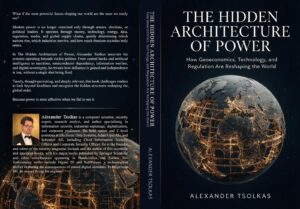
THE HIDDEN ARCHITECTURE OF POWER
Alexander Tsolkas
Available now on Amazon.
English edition
https://www.amazon.de/dp/B0HL72LX7J
German edition – Die verborgene Architektur der Macht
https://www.amazon.de/dp/B0HL3ZJH5P
The book explains the architecture.
ESIR is the idea for seeing it before it becomes a crisis.